

Ventilation System for Basement
A Ventilation System for Basement helps introduce outdoor air and remove stale indoor air from enclosed or below-ground spaces. Since basements may have limited natural ventilation, the right solution depends on how the space is used, its ventilation requirements, duct layout, and moisture conditions.
INTELLIFAN offers two ventilation solutions for consideration: Fresh Air Systems and Energy Recovery Ventilators (ERVs). Fresh Air Systems supply filtered outdoor air, while ERVs combine outdoor-air supply and indoor-air exhaust with energy recovery.
Request Technical Consultation
Get recommendations and project-specific technical evaluation:
Why is Basement Ventilation Important?
Basements often have fewer opportunities for natural air exchange than above-ground rooms. Depending on the building design and intended use, this can create a need for planned mechanical ventilation.
Common considerations include:
- Limited natural ventilation: Below-ground rooms may not receive sufficient outdoor air through windows or other natural openings.
- Stale air and odours: Inadequate air exchange can allow indoor odours and airborne contaminants to accumulate.
- Occupied spaces: Basement offices, recreation rooms, and other regularly used areas may need a designed outdoor-air supply.
- Moisture and condensation: Dampness can result from condensation, water intrusion, leaks, or humid air. Ventilation may help in some circumstances, but the moisture source must also be addressed.
- Controlled air exchange: A planned ventilation system establishes how outdoor air enters the space and how indoor air is removed.
A suitable system must be selected according to the actual ventilation requirement. Installing a unit based only on basement floor area or its maximum airflow rating may not provide the required performance after ductwork and other system resistance are considered.
Recommended Ventilation Systems for Basement
The two recommended INTELLIFAN product categories are Fresh Air Systems and Energy Recovery Ventilators. The appropriate choice depends on whether the project primarily requires outdoor-air supply or needs coordinated supply and exhaust with energy recovery.
Fresh Air System for Basement
A Fresh Air System introduces outdoor air into an indoor space through a controlled ventilation arrangement. Depending on the model, the unit may include multiple filtration stages and connect to a ducted air-distribution system.
For basement applications, a Fresh Air System may be considered when the primary objective is to supply filtered outdoor air. The overall design must also account for how indoor air will leave the basement; a fresh-air supply unit should not automatically be treated as a complete balanced ventilation system.
When evaluating a Fresh Air System, consider the required airflow, filter arrangement, duct diameter, static pressure, available installation space, and the basement's intended use.
INTELLIFAN Fresh Air System Series
Browse verified high-performance residential fresh air and hybrid air purification systems engineered for apartments, villas, and modern residences.
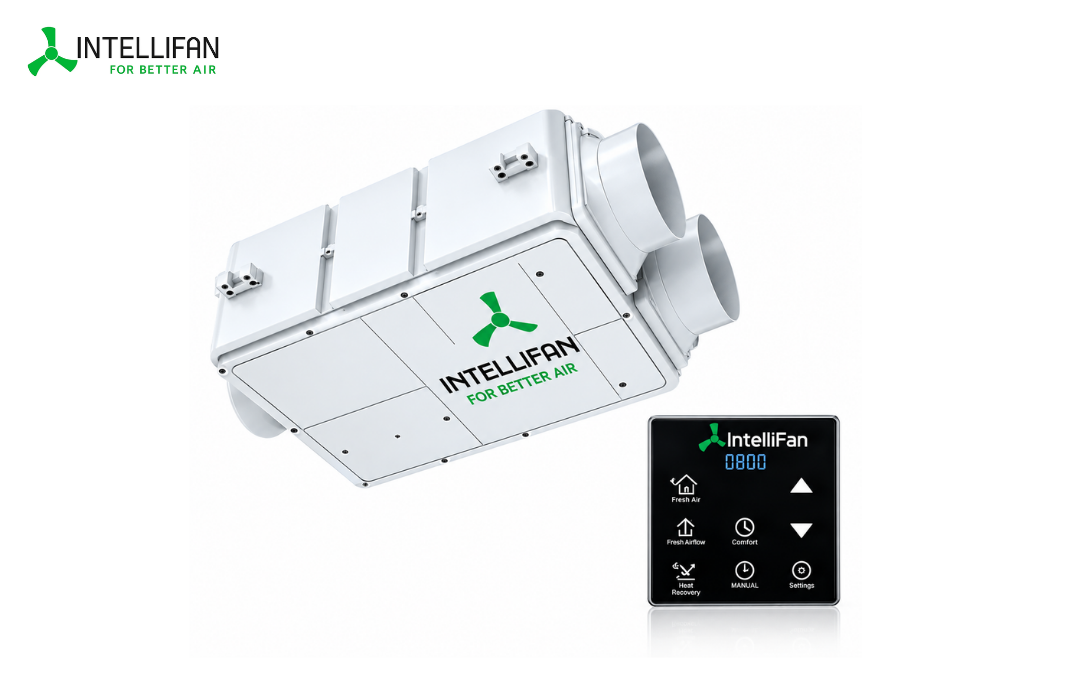
INTELLIFAN Hybrid Fresh Air System (350 CMH)
| Model Number | IN HFF 350H |
| Operation Mode | Mixed, Fresh Air, Recirculation |
| Airflow | 370 m³/h |
| Static Pressure | 80 Pa |
| Power Consumption | 150 Watt |
| Noise Level | 40 dB(A) |
| Filters | Pre + HEPA |
| Duct Size | 150 mm |
| Dimensions (L×W×H) | 500 × 430 × 210 mm |
| Net Weight | 6 Kg |
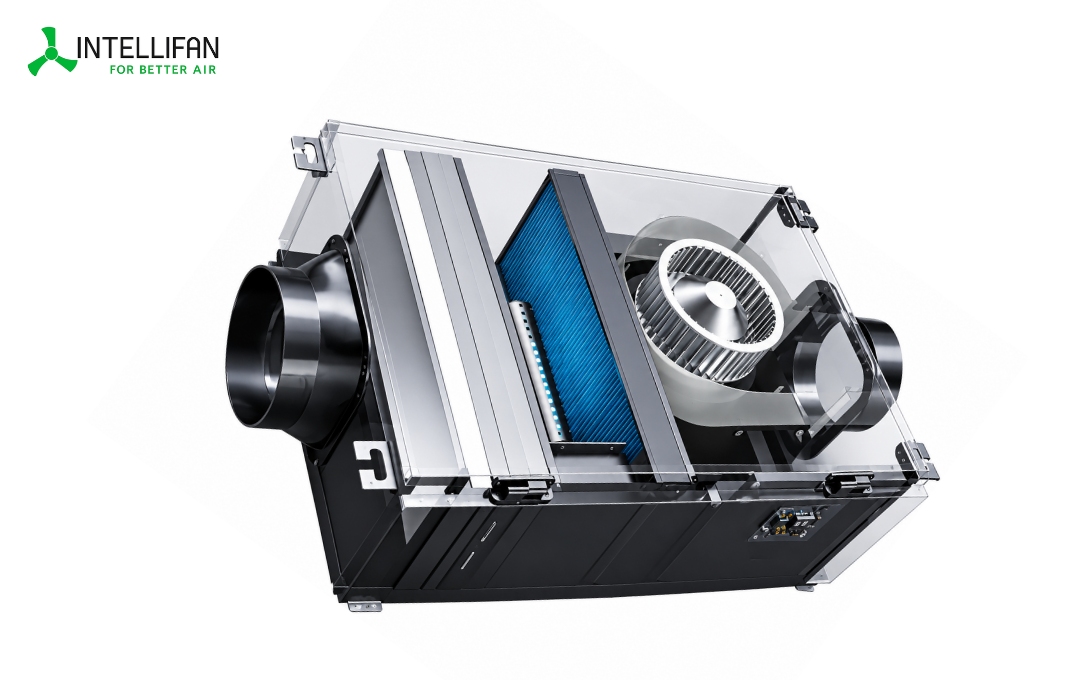
INTELLIFAN 180 CMH Fresh Air System
| Model Number | IN HFF180 |
| Airflow | 180 m³/h |
| Static Pressure | 160 Pa |
| Speed Control | 2 Speeds |
| Power Consumption | 45 Watt |
| Noise Level | 31 dB(A) |
| Filters | Pre + Fine + Carbon + H13 HEPA |
| Duct Size | 100 mm |
| Dimensions (L×W×H) | 420 × 367 × 120 mm |
| Net Weight | 8 Kg |

INTELLIFAN 450 CMH Fresh Air System
| Model Number | IN HFF450 |
| Airflow | 450 m³/h |
| Static Pressure | 210 Pa |
| Speed Control | 2 Speeds |
| Power Consumption | 75 Watt |
| Noise Level | 38 dB(A) |
| Filters | Pre + Fine + Carbon + H13 HEPA |
| Duct Size | 150 mm |
| Dimensions (L×W×H) | 420 × 367 × 120 mm |
| Net Weight | 10 Kg |

INTELLIFAN 500 CMH Fresh Air System
| Model Number | IN HFF500MF |
| Airflow | 500 m³/h |
| Static Pressure | 185 Pa |
| Speed Control | 3 Speeds |
| Power Consumption | 110 Watt |
| Noise Level | 31 dB(A) |
| Filters | Pre + Fine + Carbon + H13 HEPA |
| Duct Size | 200 mm |
| Dimensions (L×W×H) | 550 × 482 × 258 mm |
| Net Weight | 14.8 Kg |

INTELLIFAN 800 CMH Fresh Air System
| Model Number | IN HFF800MF |
| Airflow | 800 m³/h |
| Static Pressure | 225 Pa |
| Speed Control | 3 Speeds |
| Power Consumption | 125 Watt |
| Noise Level | 32 dB(A) |
| Filters | Pre + Fine + Carbon + H13 HEPA |
| Duct Size | 200 mm |
| Dimensions (L×W×H) | 600 × 482 × 336 mm |
| Net Weight | 20 Kg |
Explore the full Fresh Air Ventilation System Manufacturer in India range for detailed specifications and product enquiries.
Energy Recovery Ventilator (ERV) for Basement
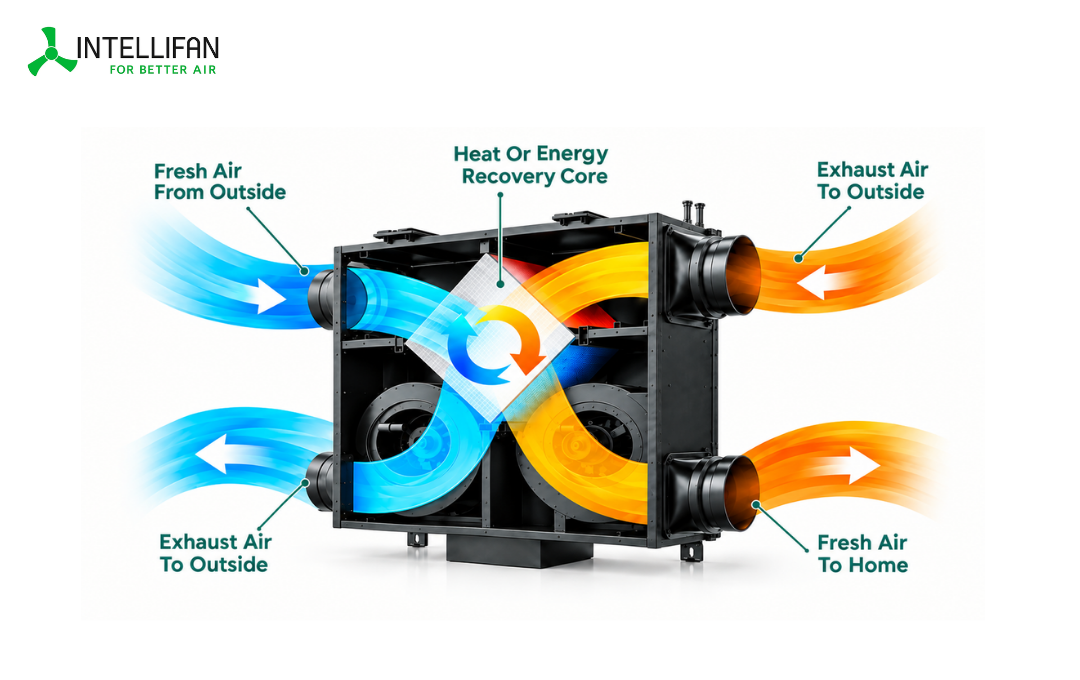
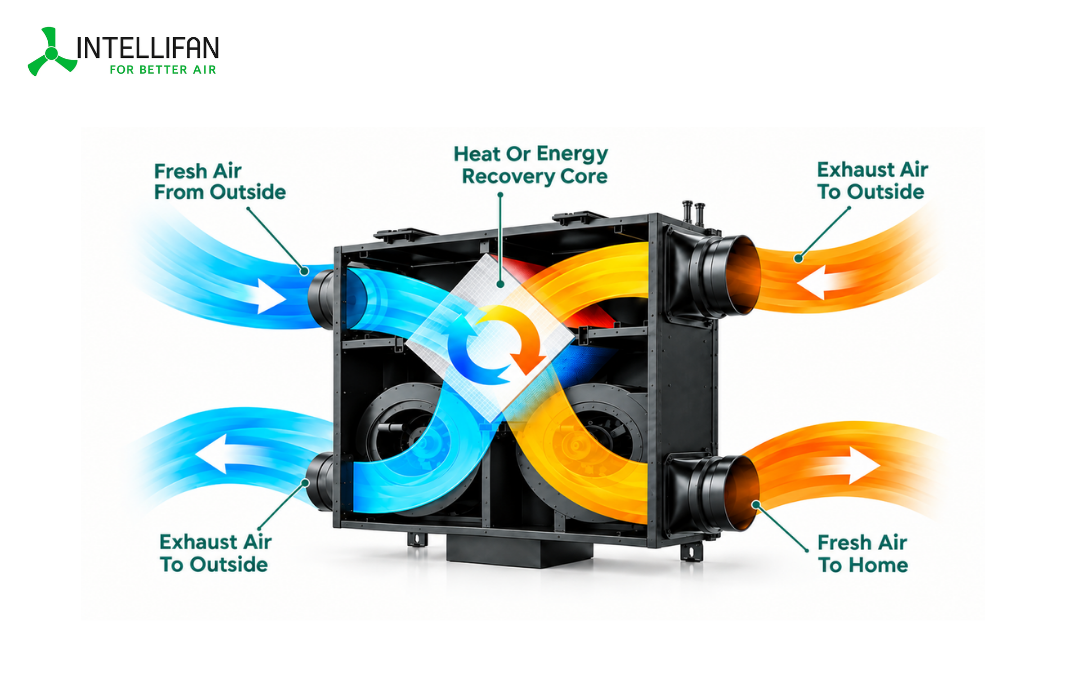
An Energy Recovery Ventilator supplies outdoor air and extracts indoor air through separate airflow paths. Its energy-recovery core transfers energy between the incoming and outgoing air streams without intentionally mixing them.
For basement projects that require both controlled fresh-air supply and stale-air exhaust, an Energy Recovery Ventilator Manufacturer in India model may be worth evaluating. Its energy-recovery function can help reduce the ventilation-related heating or cooling load under suitable operating conditions.
INTELLIFAN ERVs use Graphene Enthalpy Cores and multi-stage filtration, according to the supplied product specifications. The actual benefit depends on indoor and outdoor conditions, equipment operation, and the overall ventilation design.
An Energy Recovery Ventilator should not be considered a universal solution for basement dampness. Persistent seepage, leaks, and condensation require separate investigation and corrective action.
INTELLIFAN Energy Recovery Ventilator (ERV) Series
Balanced, high-efficiency mechanical ventilation engineered with Graphene Enthalpy Cores and true multi-stage filtration to recover sensible and latent energy while delivering fresh indoor air.
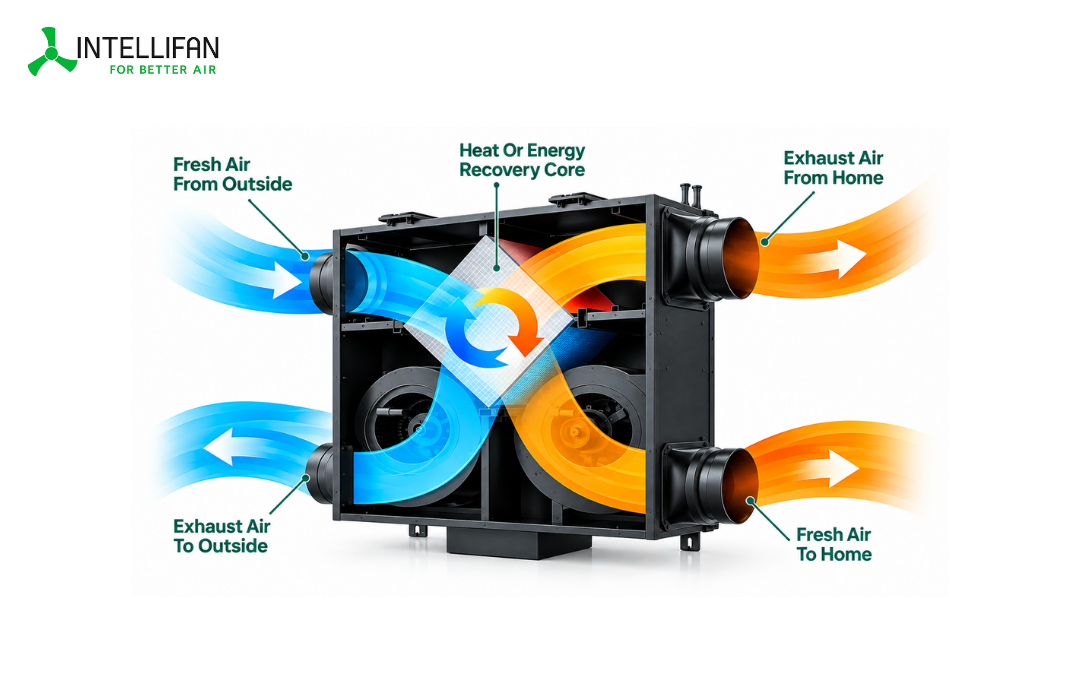
INTELLIFAN Energy Recovery Ventilator 350 CMH
| Model | IN ERV 350Z |
| Air Volume | 350 m³/h |
| Static Pressure | 145 Pa |
| Heat Exchanger Type | Graphene Core |
| Filters | 2x Pre-filters, Activated Carbon, HEPA 13 |
| Power Consumption | 95W |
| Noise | 29 dB(A) |
| Dimensions | 750 × 630 × 275 / 150 mm |
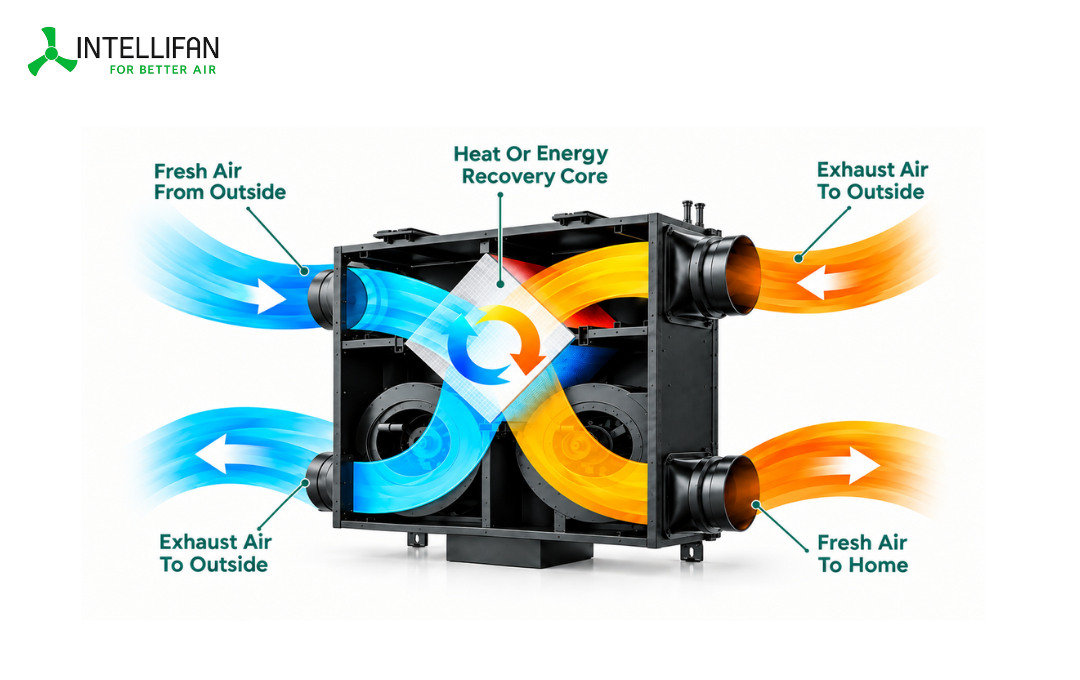
INTELLIFAN Energy Recovery Ventilator 500 CMH
| Model | IN ERV 500Z |
| Air Volume | 500 m³/h |
| Static Pressure | 165 Pa |
| Heat Exchanger Type | Graphene Core |
| Filters | 2x Pre-filters, Activated Carbon, HEPA 13 |
| Power Consumption | 125W |
| Noise | 30 dB(A) |
| Dimensions | 750 × 630 × 275 / 150 mm |
INTELLIFAN Energy Recovery Ventilator 800 CMH
| Model | IN ERV 800Z |
| Air Volume | 800 m³/h |
| Static Pressure | 170 Pa |
| Heat Exchanger Type | Graphene Core |
| Filters | 2x Pre-filters, Activated Carbon, HEPA 13 |
| Power Consumption | 150W |
| Noise | 30 dB(A) |
| Dimensions | 1260 × 740 × 380 / 200 mm |
INTELLIFAN Energy Recovery Ventilator 1000 CMH
| Model | IN ERV 1000Z |
| Air Volume | 1000 m³/h |
| Static Pressure | 175 Pa |
| Heat Exchanger Type | Graphene Core |
| Filters | 2x Pre-filters, Activated Carbon, HEPA 13 |
| Power Consumption | 200W |
| Noise | 35 dB(A) |
| Dimensions | 1260 × 740 × 380 / 200 mm |
Explore Energy Recovery Ventilator Manufacturer in India for detailed specifications and product enquiries.
Fresh Air System vs ERV for Basement Ventilation
Fresh Air Systems and ERVs serve related but different purposes. The key distinction is how incoming and outgoing air are managed.
| Selection Factor | Fresh Air System | Energy Recovery Ventilator (ERV) |
|---|---|---|
| Primary function | Supplies outdoor air | Supplies outdoor air and exhausts indoor air |
| Stale-air removal | Depends on the complete ventilation design | Integrated supply and exhaust functions |
| Energy recovery | Not specified for the listed standard models | Uses an energy-recovery core |
| Filtration | Varies by model | Multi-stage filtration in the supplied range |
| Main selection factors | Required supply airflow, filtration, duct resistance | Supply and exhaust airflow, energy recovery, duct resistance, HVAC design |
Which should you consider?
A Fresh Air System may be appropriate when the primary requirement is filtered outdoor-air supply and the exhaust arrangement is addressed separately. An Energy Recovery Ventilator may be suitable for evaluation when both controlled supply and exhaust are required alongside energy recovery.
Neither product category should be selected solely by comparing maximum airflow or price. The required ventilation performance and installation conditions should guide the decision.
How to Choose the Right Basement Ventilation System
Before choosing a model, assess the following factors.
1. Basement dimensions and intended use
Record the room dimensions, ceiling height, layout, and intended use. A residential recreation room, commercial office, storage area, and underground parking facility may have substantially different ventilation requirements.
2. Required airflow
Determine the required outdoor-air supply and exhaust rates using the applicable design criteria, occupancy, and intended use. Basement volume is useful information, but it does not independently establish the required airflow.
3. Duct layout and static pressure
Duct length, diameter, bends, filters, grilles, dampers, and diffusers affect system resistance. The selected unit must be evaluated against the expected operating conditions, not just its nominal airflow rating.
4. Filtration requirements
Choose the filter arrangement according to outdoor-air quality and the contaminants relevant to the application. Filter maintenance and replacement access should also be considered.
5. Moisture and condensation
Identify whether moisture is associated with humid air, condensation, water seepage, plumbing leaks, or another source. Ventilation may form part of the solution, but it does not replace waterproofing, leak repairs, or dedicated dehumidification when required.
6. Installation and building requirements
Check available equipment space, duct routes, electrical requirements, maintenance access, and applicable building and fire-safety provisions. Underground parking requires a separate application-specific engineering assessment.
Basement Ventilation Applications
Residential basements
Finished basements, recreation rooms, home offices, and other occupied spaces may need mechanical outdoor-air supply when natural ventilation is insufficient. The selected system should match the room's use and the home's wider ventilation arrangement.
Commercial basements
Commercial spaces may have varying occupancy, operating hours, equipment loads, and indoor-air-quality requirements. These conditions should be assessed before selecting the ventilation system and its capacity.
Basement gyms and activity rooms
Occupancy and activity levels can influence ventilation requirements in exercise spaces. The system should be selected according to the intended use and applicable design criteria rather than a generic room-size recommendation.
Underground parking areas
Underground parking has distinct ventilation and safety considerations, including vehicle emissions, ventilation zoning, and applicable fire-safety requirements. A standard residential Fresh Air System or ERV should not be assumed suitable for parking without specific engineering review.
Frequently Asked Questions About Basement Ventilation
Which ventilation system is suitable for a basement?
A Fresh Air System may suit a basement that primarily needs controlled outdoor-air supply. An Energy Recovery Ventilator may be worth considering when the project also requires integrated indoor-air exhaust and energy recovery. The final choice depends on the building's use, calculated airflow, duct resistance, and other design requirements.
Is a fresh air system necessary for a basement?
A basement with limited natural ventilation may require mechanical outdoor-air supply, depending on its intended use and applicable ventilation criteria. A building-specific assessment is needed to establish the requirement.
What is the difference between a Fresh Air System and an ERV?
A Fresh Air System supplies outdoor air, with stale-air removal addressed by the overall ventilation design. An Energy Recovery Ventilator combines outdoor-air supply and indoor-air exhaust with energy transfer between the two air streams.
How do I calculate the required airflow for a basement?
Start with the basement's dimensions, intended use, occupancy, and applicable ventilation criteria. Then assess duct resistance and the required operating airflow before selecting equipment. Room volume alone is not enough to determine the correct model.
Can basement ventilation help with dampness?
Ventilation may help manage some indoor moisture conditions, depending on the outdoor air and operating conditions. It cannot reliably correct water seepage, plumbing leaks, or every condensation problem. Persistent dampness should be investigated to identify and address the underlying cause.
Which INTELLIFAN model is suitable for my basement?
INTELLIFAN offers Fresh Air Systems with listed airflow capacities from 180 to 800 m³/h and ERVs from 350 to 1,000 m³/h. These figures describe the supplied product range, not the suitability of an individual model for a specific basement. The required airflow, duct layout, intended use, and installation conditions must be assessed before a model is recommended.
Get a Basement Ventilation Recommendation
Selecting a basement ventilation system starts with understanding the space, its outdoor-air requirements, and how indoor air will be removed. INTELLIFAN offers Fresh Air Systems and Energy Recovery Ventilators for projects with different ventilation objectives.
To discuss a suitable approach for your basement, share your project details including dimensions, occupancy, layout, and moisture conditions.
Direct Consultation Form
Submit your project requirements for quick sizing and product assistance:
