

Ventilation System for Dental Clinic
Quick answer: A ventilation system for a dental clinic supplies filtered outdoor air, exhausts stale or contaminated air, controls airflow direction between rooms, and works with source capture (high-volume suction) to remove aerosols, nitrous oxide, fumes and heat.
A common design baseline for operatories is 6 air changes per hour (ACH) minimum, 8 to 12 ACH where aerosol-generating procedures are frequent, with at least 2 ACH of outdoor air. Confirm exact values with local code and a licensed HVAC engineer.
INTELLIFAN, a premier Fresh Air Ventilation System Manufacturer in India, makes the fresh air systems, ERVs, inline fans, exhaust fans, air circulator fans and IAQ monitors used to build these systems.
Get a ventilation plan for your dental clinic
Share your clinic layout, number of chairs, city and whether it is a new build or retrofit. The INTELLIFAN team will recommend a fresh air, ERV and fan configuration.
Dental clinic ventilation at a glance
| Parameter | Common design reference | Note |
|---|---|---|
| Operatory air changes | 6 ACH minimum; 8-12 ACH for aerosol-heavy work | UK guidance has discussed 10 ACH; confirm local requirement |
| Outdoor air | At least 2 ACH of the total | Remainder can be filtered recirculation or extra extraction |
| Pressure | Operatory neutral to slightly negative to corridor; sterilization and lab negative | Set by exhaust vs supply balance |
| Supply filtration | MERV 13 or better is a common target | Check pressure drop against fan capacity using proper Ventilation Accessories |
| Nitrous oxide | Active scavenging, discharged outdoors; NIOSH recommends exposure below 25 ppm during administration | Keep discharge away from intakes |
| CO₂ as ventilation indicator | Outdoor about 420-450 ppm; many designers aim well below 1,000 ppm indoors | CO₂ does not measure aerosols or nitrous oxide |
| Temperature and humidity | About 21-24°C, 30-60% RH | For comfort and equipment |
These values are widely used design references drawn from guidance such as ASHRAE 62.1 and 170, CDC and NIOSH dental guidance, and UK SDCEP guidance. They are not a substitute for the requirement that applies in your jurisdiction.
Consult Our Clinic Ventilation Specialist →What is a ventilation system for a dental clinic?
A dental clinic ventilation system is a combination of fans, ducts, filters, controls and airflow paths that manages the air inside the clinic. It typically does the following:
- Brings in filtered outdoor air
- Exhausts stale air from clinical and support rooms
- Controls airflow direction and room pressure
- Removes odors, moisture, fumes and equipment heat
- Provides local exhaust for sterilization, lab and compressor areas
- Monitors indoor air quality
A clinic with one or two chairs may need a simple arrangement, while a multi-chair clinic with sterilization, lab and imaging rooms needs a planned, ducted system—much like specialized commercial designs used in a Ventilation System for office or a high-traffic Ventilation System for gym.
Why do dental clinics need mechanical ventilation?
Drilling, ultrasonic scaling and air-water spray generate aerosols and splatter. A clinic also has nitrous oxide, disinfectant and lab fumes, and heat from compressors and vacuum pumps. Ventilation dilutes and removes these airborne contaminants. It should be one layer within infection control, alongside source capture, PPE and sterilization protocols, not a replacement for them.
A study of 104 dental practices in New Zealand found that most had no mechanical ventilation system, which shows how often this gap exists. Mechanical ventilation gives a measurable, repeatable air change rate that open windows cannot.
Is a split AC enough for a dental clinic?
No. A split AC cools and recirculates the air already in the room. It does not supply outdoor air or exhaust contaminated air. UK SDCEP guidance makes the same distinction: air conditioning and air cleaners are not themselves a source of ventilation. A dental clinic usually needs both air conditioning for temperature and a fresh air system for air exchange—a principle equally vital when installing a Ventilation System for Home.
| Feature | Fresh outdoor air | Recirculated indoor air |
|---|---|---|
| Source | Outside the building | Inside the clinic |
| Purpose | Dilutes CO₂, odors and airborne contaminants | Cooling, heating and circulation |
| Provided by | Fresh air system, ERV | Split AC, ducted AC |
| Replaces the other? | No | No |
How many air changes per hour (ACH) does a dental operator need?
ACH is the number of times the air volume of a room is replaced in one hour.
Formula: ACH = Airflow (m³/h) ÷ Room volume (m³)
Rearranged: Airflow (m³/h) = Room volume (m³) × ACH
Unit conversion: 1 m³/h ≈ 0.589 CFM
Design references commonly used for operatories are:
- 6 ACH total as a baseline minimum
- 8 to 12 ACH where aerosol-generating procedures are frequent
- At least 2 ACH of outdoor air
A 2023 study at two UK dental settings found significantly lower air contamination at 10 ACH than at 6 ACH in open-bay clinics. UK guidance has also linked higher ACH to shorter downtime between patients, and recommends a longer baseline downtime where the air change rate is unknown or only 1 to 5 ACH. Requirements differ by country and room type, so no single number applies to every clinic.
Worked sizing example
Operatory dimensions: 3 m × 3.5 m × 3 m
| Step | Calculation | Result |
|---|---|---|
| Room volume | 3 × 3.5 × 3 | 31.5 m³ |
| Total airflow at 8 ACH | 31.5 × 8 | about 252 m³/h (about 148 CFM) |
| Outdoor air at 2 ACH | 31.5 × 2 | 63 m³/h minimum |
| Exhaust | Equal to or slightly above supply | Keeps room neutral to slightly negative |
For a multi-chair clinic, repeat the calculation per room and add sterilization, toilets, lab and reception. Then add the static pressure of the duct system before choosing the fan (see the fan selection section).
Ventilation vs air purifiers vs source capture
These three are often confused. They do different jobs, and the best design uses all three.
| Measure | What it does | What it does not do |
|---|---|---|
| Mechanical ventilation (fresh air system, ERV, exhaust) | Brings in outdoor air, removes stale air, dilutes aerosols, CO₂ and fumes | Does not capture aerosol at the source |
| Source capture (high-volume evacuation, extraoral suction) | Removes aerosol near the patient's mouth; the first line of control | Does not supply fresh air or control humidity |
| Air purifier / HEPA unit | Filters recirculated room air and adds effective air changes for particles | Does not bring in fresh air or remove CO₂, nitrous oxide or fumes |
Airflow direction and negative pressure: what should a dental clinic do?
Not every room needs to be a negative-pressure room. The better question is which pressure relationship and airflow path each room needs.
- Air should move from cleaner areas toward less clean areas, as healthcare ventilation guidance such as ASHRAE's healthcare chapter describes.
- Operatories are commonly kept neutral to slightly negative to the corridor.
- Sterilization rooms, labs and toilets are kept negative so air does not flow into clean areas.
- Pressure comes from the balance of supply and exhaust airflow, so it must be measured during commissioning.
- Place supply and exhaust at different points to avoid short-circuiting, where fresh air leaves directly through the exhaust without ventilating the occupied zone.
INTELLIFAN Ventilation products for dental clinics
INTELLIFAN, a unit of Greenland Solutions and an ISO 9001:2015 certified Indian manufacturer, offers the following products for dental clinic ventilation. Final selection should follow airflow and static pressure calculations.
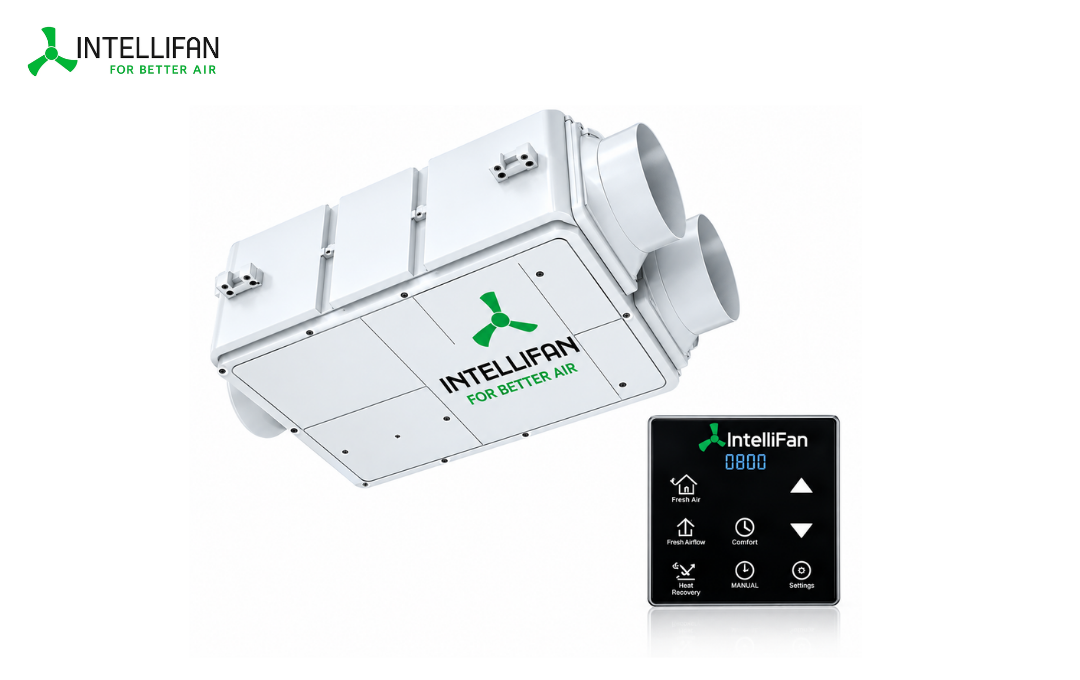
INTELLIFAN Fresh Air Ventilation System
What it does: supplies controlled, filtered outdoor air into the clinic
Best for: operatories, waiting area, consultation and staff rooms
Dental use: the primary source of outdoor air that dilutes CO₂, odors and aerosols
Watch out for: it must be paired with exhaust for balanced airflow; filters need regular replacement
Model data: see the product page and INTELLIFAN Catalog 2026 for airflow, filtration, noise and power data
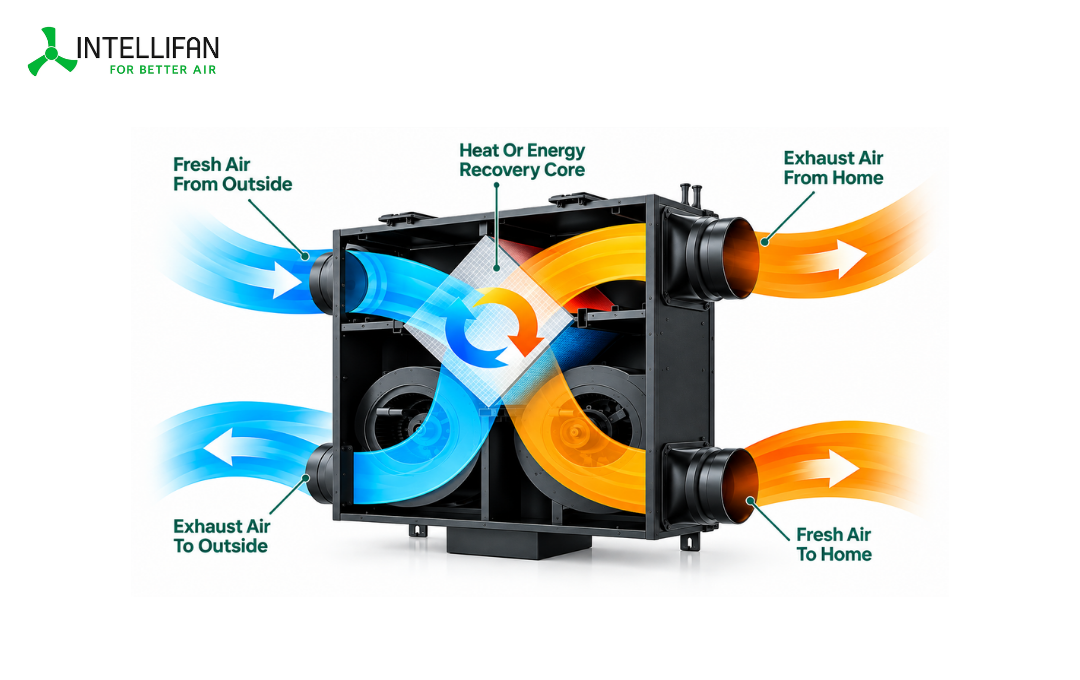
INTELLIFAN Energy Recovery Ventilator (ERV)
What it does: supplies outdoor air and exhausts indoor air while transferring heat and moisture between the two streams
Best for: air-conditioned clinics operating long hours in hot, humid weather
Dental use: reduces the cooling load of bringing in outdoor air
Watch out for: use a sealed-core design for clinical areas; do not route sterilization or lab exhaust through the energy recovery core
Model data: see the product page and INTELLIFAN Catalog 2026 for airflow, filtration, noise and power data
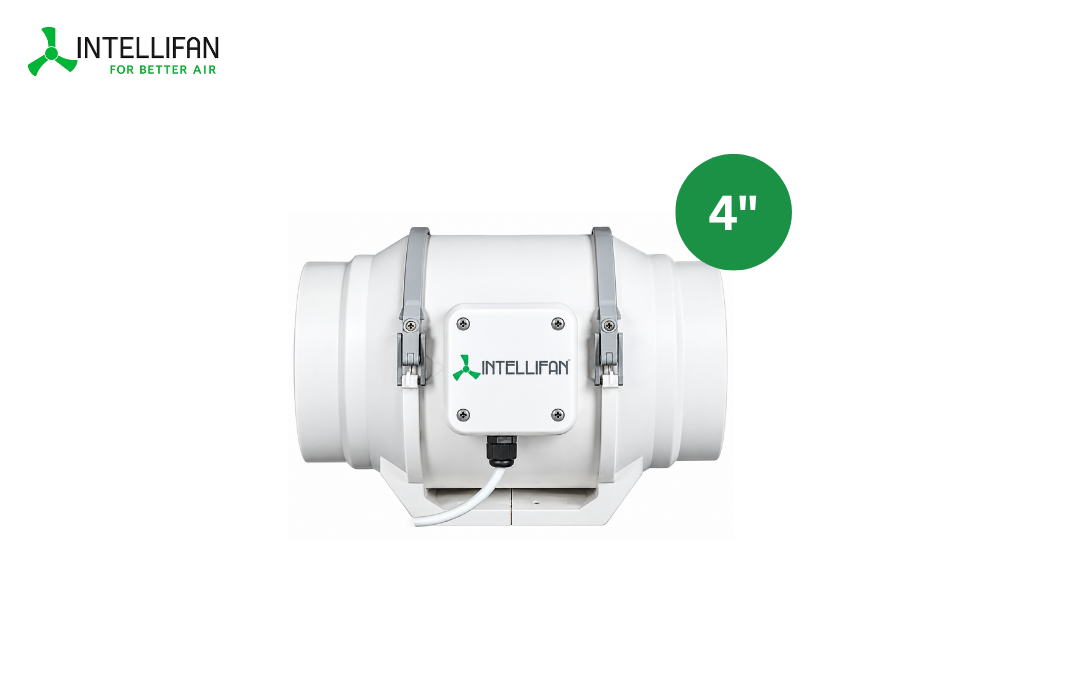
INTELLIFAN Inline Duct Fan
What it does: moves air through duct branches for supply or exhaust
Best for: compact ducted extraction above false ceilings
Dental use: toilet, utility and small-room extraction, supplementary exhaust
Watch out for: check static pressure rating against the actual duct run, not airflow alone
Model data: see the product page and INTELLIFAN Catalog 2026 for full details
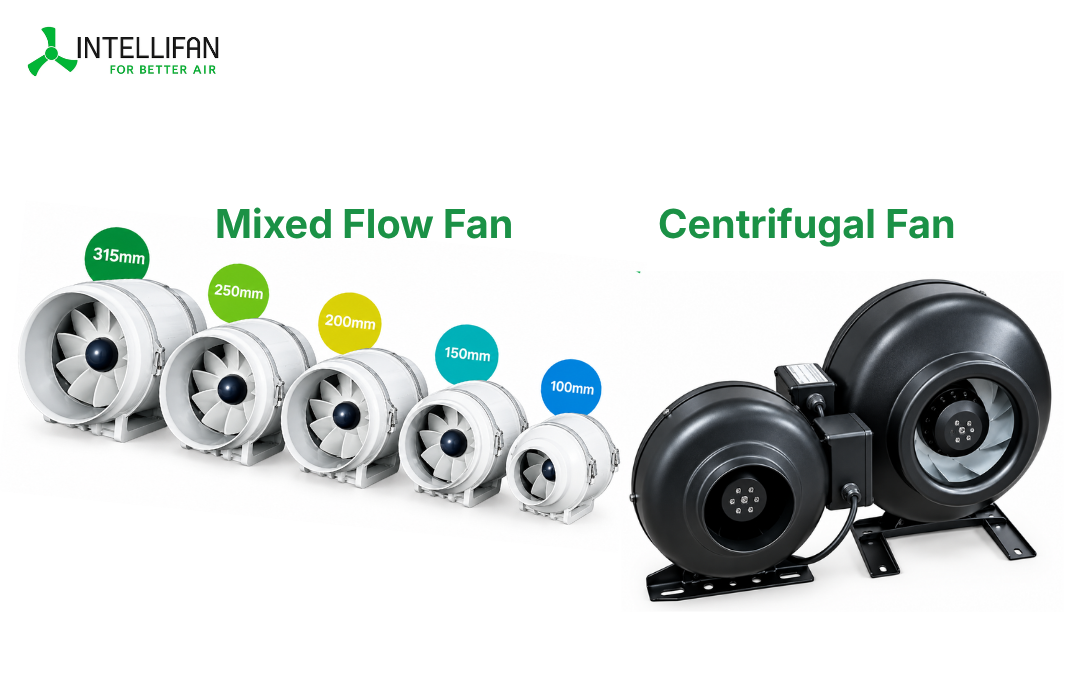
INTELLIFAN Mixed Flow Inline Fan
What it does: delivers higher airflow at moderate pressure with relatively low noise
Best for: multi-room extraction and longer duct runs where space is limited
Dental use: sterilization room, compressor room, shared extraction branches
Watch out for: size from the fan curve at the real operating point
Model data: see the product page and INTELLIFAN Catalog 2026 for full details
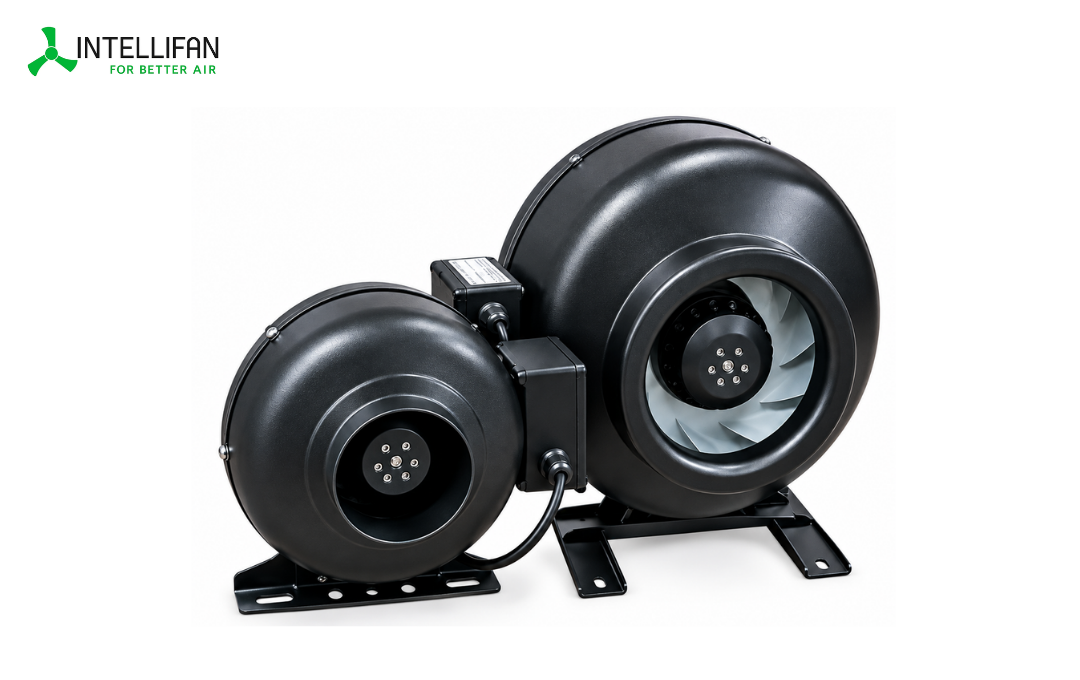
INTELLIFAN Centrifugal Inline Fan
What it does: maintains airflow against high static pressure
Best for: duct systems with filters, many bends or long runs
Dental use: lab local exhaust, filtered extraction, remote fan installations
Watch out for: typically higher noise at high duty; use vibration isolation and maintenance access
Model data: see the product page and INTELLIFAN Catalog 2026 for full details
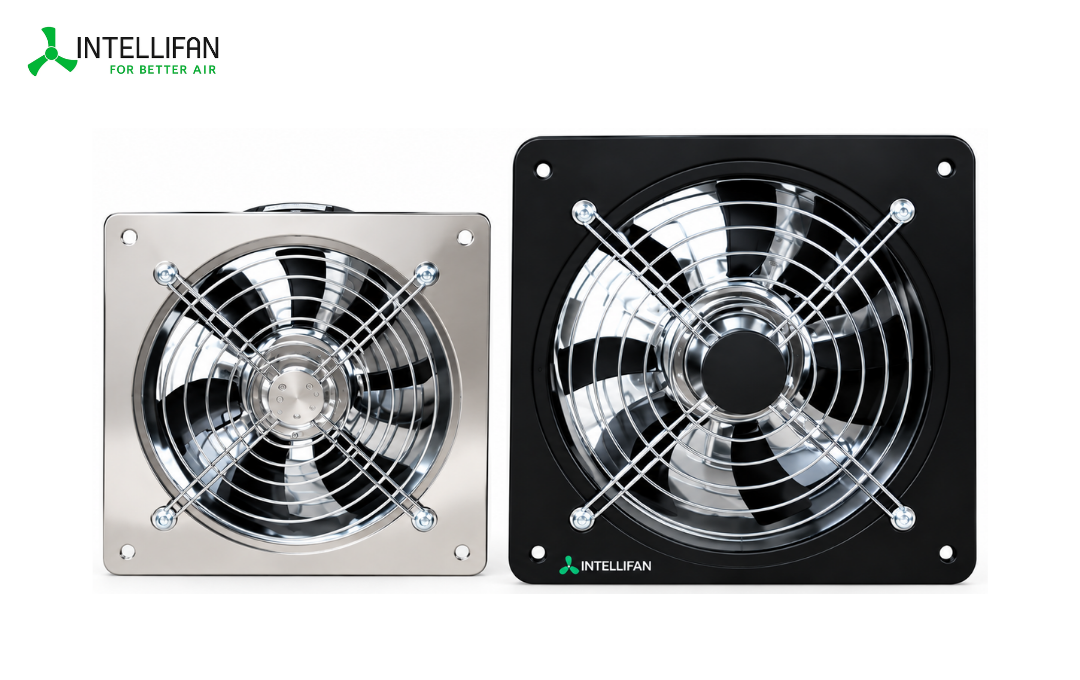
INTELLIFAN Exhaust Fan
What it does: removes stale air, moisture and odors from a defined area
Best for: toilets, X-ray rooms, utility and dirty-utility areas
Dental use: local extraction where a ducted system is not needed
Watch out for: needs make-up air; position the discharge away from fresh air intakes
Model data: see the product page and INTELLIFAN Catalog 2026 for full details
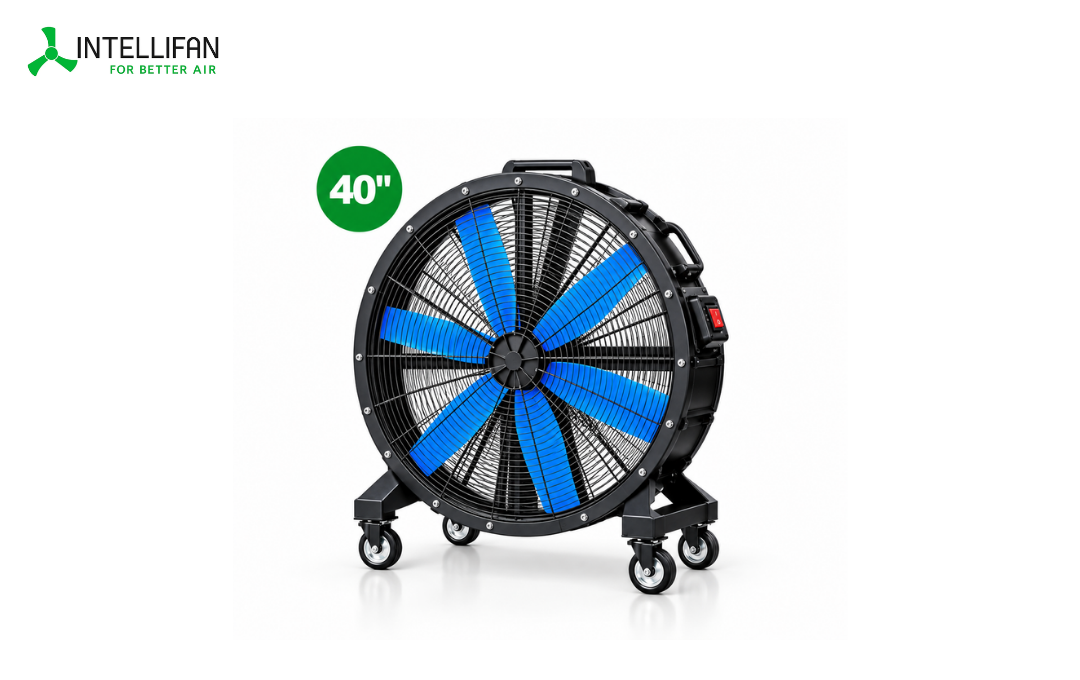
INTELLIFAN Air Circulator Fan
What it does: moves air already inside a room to improve mixing and comfort
Best for: waiting area, reception and staff rooms
Dental use: comfort in non-clinical areas only
Watch out for: it is not ventilation. Do not use it in treatment areas, where airflow can carry aerosols across the room or toward staff
Model data: see the product page and INTELLIFAN Catalog 2026 for full details

INTELLIFAN IAQ Monitor
What it does: measures indoor air conditions such as CO₂, PM2.5, temperature and humidity (confirm exact parameters for your model: [parameters])
Best for: verifying that ventilation performs as designed
Dental use: CO₂ trends during busy hours and after aerosol-generating procedures
Watch out for: it measures conditions; it does not create ventilation, and CO₂ is not a direct measure of every airborne contaminant
Fresh air system vs exhaust fan: which is better?
An exhaust fan alone removes air, so replacement air enters through door gaps and corridors untreated, bringing heat, humidity and dust. A fresh air system supplies filtered outdoor air in a controlled path. The balanced design combines both: supply to operatories, extraction at sterilization, lab, toilets and compressor rooms, with make-up air planned for every exhaust. As a leading Exhaust Fan Manufacturer in Ghaziabad and Fresh Air Ventilation System Manufacturer in Delhi, INTELLIFAN engineers systems where intake and extraction operate in perfect harmony.
Room-by-room ventilation plan
| Room | Main concern | Recommended approach | INTELLIFAN products |
|---|---|---|---|
| Operatory | Aerosols, CO₂, nitrous oxide | Balanced fresh air and extraction, source capture, optional HEPA unit | Fresh Air System or ERV, Inline or Mixed Flow Fan, IAQ Monitor |
| Sterilization room | Fumes, heat, humidity | Dedicated exhaust, negative pressure, no recirculation | Mixed Flow or Centrifugal Inline Fan, Exhaust Fan |
| Dental lab | Dust, vapors | Local exhaust at the source, dedicated discharge | Centrifugal Inline Fan |
| X-ray room | Heat, small volume | Basic extraction | Ceiling Exhaust Fan or standard Exhaust Fan |
| Toilet | Odor, moisture | Continuous or timed extraction | Exhaust Fan or Inline Duct Fan |
| Compressor and vacuum room | Heat | Thermostat-controlled exhaust with make-up air | Mixed Flow or Inline Fan |
| Waiting area and reception | CO₂, comfort | Fresh air supply plus comfort circulation | Fresh Air System or ERV, Air Circulator Fan |
| Whole clinic | Verification | Continuous air quality tracking | IAQ Monitor |
Special areas: nitrous oxide, sterilization, lab and compressor
- Nitrous oxide: use active scavenging through a dedicated line or exhaust, discharged outdoors away from air intakes. NIOSH recommends keeping exposure below 25 ppm during administration.
- Sterilization room: evaluate separately from operatories. Heat, moisture and chemical fumes call for dedicated exhaust, and air from here should not be recirculated to other rooms.
- Dental lab: grinding and polishing generate dust and vapors. Local exhaust at the source is more effective than general room ventilation. Built by a dedicated Centrifugal Inline Fan Manufacturer in Delhi, our heavy-duty blowers handle this resistance reliably.
- Amalgam and mercury: use amalgam separators and good general exhaust where amalgam is handled.
- Compressor and vacuum pump: provide dedicated ventilation. A thermostat-controlled exhaust fan with make-up air is common.
HEPA air purifiers: do they replace ventilation?
No. A HEPA unit filters recirculated air and adds effective air changes for particles, which can help in closed operatories. It does not supply outdoor air or remove CO₂, nitrous oxide or fumes. Use it as a supplement to mechanical ventilation and source capture.
IAQ monitoring: how to confirm the system is working
An IAQ monitor shows whether conditions stay within a healthy range over time. CO₂ is a useful ventilation indicator because it rises when fresh air supply is low for the number of people present. A monitor supports, but does not replace, airflow measurement at commissioning.
- Install at breathing height in a representative room, away from doors, windows and supply diffusers
- Log readings during busy hours and after aerosol-generating procedures
- Review the trend monthly and investigate persistent high CO₂ or humidity
- Re-test airflow if readings change after a layout or equipment change
How to design a dental clinic ventilation system: step by step
1. Room Inventory
List every room and its function: operatories, sterilization, lab, X-ray, toilets, compressor, waiting, reception.
2. Occupancy & Procedures
Estimate occupancy and identify aerosol-generating procedures.
3. Codes & Standards
Check the applicable requirement in local code, dental council guidance and healthcare standards.
4. Airflow Calculations
Calculate airflow per room using volume × ACH, and the outdoor air share.
5. Pressure & Direction
Set airflow direction and pressure: clean to less clean, with exhaust equal to or slightly above supply in operatories.
6. Fresh Air Unit / ERV Selection
Select the fresh air unit or ERV with suitable filtration from a verified Energy Recovery Ventilator Manufacturer in Delhi.
7. Static Pressure & Fan Sizing
Calculate static pressure for each duct run and select inline, mixed flow or centrifugal fans at the operating point from an established Mixed Flow Inline Fan Manufacturer in Noida or Centrifugal Inline Fan Manufacturer in Noida.
8. Separation of Terminations
Place intakes and discharges away from each other, from vacuum pump discharge, nitrous oxide scavenging discharge and plumbing vents.
9. Controls & Monitoring
Add controls and monitoring: timers or CO₂-based control, a post-procedure purge cycle, and an IAQ monitor.
10. Commissioning
Commission: measure and balance airflow at each grille and confirm pressure relationships before opening.
Closed operatories with doors are easier to ventilate than open bays. In open bays, space chairs apart and rely on directional airflow and extraoral suction.
Book Technical System Commissioning Support →Common dental clinic ventilation mistakes
- Treating air conditioning as fresh air ventilation
- Selecting a fan by maximum airflow without checking static pressure
- Installing exhaust without make-up air
- Applying one ACH value to every room
- Poor supply and exhaust positioning that causes short-circuiting
- Using an air circulator in a treatment area or as a replacement for ventilation
- Treating a HEPA unit as a replacement for outdoor air
- Discharging exhaust near an outdoor air intake
- Skipping airflow balancing and commissioning
- Installing an IAQ monitor with no plan to act on the readings
- Ignoring noise in patient areas
Ventilation for hot, humid and dusty conditions in India
In Delhi NCR and other North Indian cities, summer heat, monsoon humidity and winter pollution all affect design whether setting up a Ventilation System in Delhi, a Ventilation System in Agra, a Ventilation System in Chandigarh, or a Ventilation System in Yamunanagar.
Treat incoming air
Untreated outdoor air adds heat and moisture to the AC load. An ERV from an experienced Energy Recovery Ventilator Manufacturer in Ghaziabad transfers heat and moisture between the exhaust and supply streams, which can reduce that load.
Filter for dust and PM2.5
Choose supply filters that suit local air and inspect them often during high-pollution months.
Plan for power interruptions and noise
Check restart behavior and choose low-noise fans for patient areas.
Choose energy-efficient equipment
INTELLIFAN's DC and BLDC fan technology background focuses on lower power use for continuous-running equipment. As a pioneering BLDC Ceiling Fan Manufacturer in India (with regional expertise as a BLDC Ceiling Fan Manufacturer in Ghaziabad and BLDC Ceiling Fan Manufacturer in Delhi), our motor design principles ensure high efficiency across our commercial equipment range. [Add verified power figures for specific models.]
Dental clinic ventilation cost in India
Cost depends on the number of operatories, clinic area, required airflow, outdoor air requirement, ductwork, static pressure, fan types, ERV, filtration, controls, electrical work, ceiling access and commissioning. A price per square foot can mislead, so prepare a room-by-room schedule first.
| Clinic size | Typical scope | Indicative cost |
|---|---|---|
| 2 chairs | One fresh air unit or ERV, exhaust for toilet and sterilization, basic ducting | Quoted after a room-by-room schedule |
| 4 chairs | Fresh air unit or ERV per zone, ducted extraction, IAQ monitor and controls | Quoted after a room-by-room schedule |
| 6 chairs | Multiple fresh air units or ERVs, zoned extraction, controls and commissioning | Quoted after a room-by-room schedule |
Share your clinic layout for a project-specific estimate, since cost varies with duct length, ceiling access and capacity.
Get a Customized Project Cost Estimate →Frequently asked questions
What is a ventilation system for a dental clinic?
It is a set of fans, ducts, filters and controls that supplies outdoor air, exhausts stale air and directs airflow between rooms. Together with source capture and infection control, it dilutes aerosols, nitrous oxide, fumes and heat. It may include a fresh air system, ERV, inline fans, exhaust fans and an IAQ monitor.
How many air changes per hour does a dental clinic need?
A common design baseline is 6 ACH in operatories, with 8 to 12 ACH where aerosol-generating procedures are frequent, and at least 2 ACH of outdoor air. The exact requirement depends on local code, room function and guidance, so confirm it with a licensed HVAC engineer.
How much fresh air does a dental clinic need?
A frequently used reference is at least 2 ACH of outdoor air in operatories. For a 31.5 m³ operatory that is about 63 m³/h. The required quantity depends on occupancy, room function and the applicable standard, so calculate it room by room.
Is a split AC enough for a dental clinic?
No. A split AC cools and recirculates indoor air and does not supply outdoor air. A dental clinic needs a fresh air system or ERV for air exchange, in addition to air conditioning for temperature control.
Is an exhaust fan enough for a dental clinic?
Usually not. An exhaust fan removes air but does not supply treated replacement air, so untreated air enters through gaps. A balanced design with a fresh air unit and controlled extraction gives better aerosol control, pressure management and comfort.
Do I need an ERV in a dental clinic?
An ERV is not mandatory, but it is valuable in air-conditioned clinics in hot, humid climates because it recovers heat and moisture from exhaust air and reduces the AC load. For clinical areas, choose a sealed-core design and keep sterilization and lab exhaust out of the core.
Should a dental operatory be negative pressure?
Not automatically. Operatories are commonly kept neutral to slightly negative to the corridor, while sterilization rooms and labs are kept negative. The right pressure relationship depends on room function, standards and the intended airflow path, and it must be verified by measurement.
Can an air circulator fan replace ventilation in a dental clinic?
No. An air circulator moves air already inside the room and does not introduce outdoor air or exhaust contaminated air. Use it for comfort in waiting areas and staff rooms, and avoid it in treatment areas where it can carry aerosols.
Can a HEPA air purifier replace ventilation?
No. A HEPA purifier cleans recirculated air and adds effective air changes for particles, but it does not bring in outdoor air or remove CO₂, nitrous oxide or fumes. Use it as a supplement to mechanical ventilation and source capture.
What is the difference between an inline duct fan, a mixed flow fan and a centrifugal fan?
An inline duct fan suits short runs at low to medium pressure. A mixed flow inline fan gives higher airflow at moderate pressure with relatively low noise. A centrifugal inline fan produces higher static pressure for long ducts, filters and bends. Choose by airflow and static pressure together.
How do I know my dental clinic ventilation is working?
Measure airflow at supply and exhaust points during commissioning, confirm pressure relationships, and use an IAQ monitor to track CO₂, PM2.5, temperature and humidity. Persistently high CO₂ during busy hours suggests insufficient fresh air. Re-test annually or after any layout change.
How often should ventilation filters be changed?
It depends on outdoor air quality, running hours and filter type. In dusty or high-pollution areas, inspect filters monthly and replace them when dirty or at the manufacturer's interval. Clogged filters reduce airflow and lower the actual air changes your operator receives.
Get a ventilation plan for your dental clinic
Share your clinic layout, number of chairs, city and whether it is a new build or retrofit. The INTELLIFAN team will recommend a fresh air, ERV and fan configuration.
Contact Details
WhatsApp: +91 96250 16413
Email: Hello@intellifan.in
Address: Ground Floor, Plot no. 13, Prakash Industrial Estate, Sahibabad, Ghaziabad, UP 201005
Hours: Monday to Saturday, 10 am to 6 pm
INTELLIFAN, a unit of Greenland Solutions, is an ISO 9001:2015 certified Indian manufacturer of ventilation and indoor air quality equipment. INTELLIFAN products support better indoor air management and do not replace clinical infection-control protocols, PPE or guidance from dental and public health authorities.
Direct Consultation Form
Submit your clinic layout and requirements for product recommendations:
